2015/11/02 TrendView VIDEO: Global View (early)
© 2015 ROHR International, Inc. All International rights reserved.
The analysis videos are reserved for Gold and Platinum Subscribers
TrendView VIDEO ANALYSIS & OUTLOOK: Monday, November 2, 2015 (early)
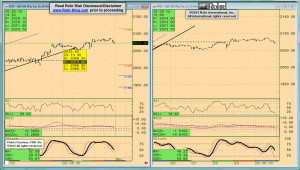 Global View: All Markets
The FOMC ‘halo’ effect on equities that typically lasts 1-3 days after an accommodative statement seemed to wear off late last Friday. While last Wednesday’s missive tried to sound more hawkish for that first hike in almost a decade still being possible into the end of this year, there were still a lot of ‘data dependent’ caveats in the statement. Specific mention of consideration of ‘whether’ to “…raise the target rate at its next meeting…” sounded fairly hawkish compared to open ended language in previous FOMC statements. Yet this seems more so confirming their desire to put through the rate increase before the end of 2015. And closer scrutiny of the FOMC statement (that links to our marked up version) shows they are still waiting to see how quite a few factors develop.
That is currently not nearly as focused on the global situation in the ‘monitoring’ language compared to the last statement specifically noting concerns there. Yet the fact is that the global situation is indeed troubling right now, and that was reinforced by the latest OECD Composite Leading Indicators earlier last month; which is something we have highlighted for many months. This also plays into all of the serial weak global economic data that now includes much of the US data as well of late.
And this gets back to the sort of influence which belies the ostensibly hawkish aspects of the FOMC statement with their continued concerns over “…some further improvement in the labor market…” after the earlier observation that… “The pace of job gains has slowed…” This is further Fed-speak double-talk for the degree to which they remain ‘data dependent’ in spite of no longer wanting to use that language. That is also why this week’s US Employment report and other data this month takes on additional importance. As the first data of the fourth quarter, it will signal whether there is any rebound after a weak Q3.
_____________________________________________________________
Video Timeline: It begins with macro (i.e. fundamental influences) mention of the central bank factors noted above. However, the addition of OECD Composite Leading Indicators reinforces all the economic weakness seen last week again. While there is also the weak influence of global Trade figures, further weakness in US Manufacturing PMI this morning along with China is not the sort of thing that will encourage Fed confidence for a rate hike.
It moves on to S&P 500 FUTURE short-term at 03:00 and intermediate term view at 05:00, OTHER EQUITIES from 07:45, GOVVIES analysis beginning at 10:45 (with the DECEMBER BUND FUTURE at 14:15) and skipping stagnant SHORT MONEY FORWARDS. FOREIGN EXCHANGE covers the US DOLLAR INDEX at 16:00, EUROPE at 18:15 and ASIA at 21:15, followed by the CROSS RATES at 24:00 and a return to S&P 500 FUTURE short term view at 28:00. We suggest using the timeline cursor to access analysis most relevant for you.
_____________________________________________________________
Authorized Gold and Platinum Subscribers click ‘Read more…’ (below) to access the balance of the opening discussion and TrendView Video Analysis and General Update. Silver and Sterling Subscribers click ‘Read more…’ (below) to access the balance of the opening discussion.
▪ And that view of global weakness is not just our view. Note our opening line of last Tuesday’s Global View TrendView video analysis post was “Draghi’s Disinflation Dirigisme = Equities Elation.” While it is more of a technical adjustment than true QE, the Peoples Bank of China rate cut a week ago Friday was also an indication of its need to balance out weakness there. Yet in terms of the specific FOMC concerns that indeed relate back to the strength of the US dollar as well as global influences, recent serial weak US Durable Goods Orders are a sign of the weakness of US manufacturing.
Some are saying this already represents at least a mild “US manufacturing recession.” Along with the abysmal figures in the last US Employment report, if the Fed is indeed ‘data driven’, then things are going to need to improve markedly (which they indeed might) for a December rate hike to make sense.
While her House Financial Services Committee testimony this Wednesday is ostensibly on supervision and regulation, Fed Chair Yellen’s remarks will need to be closely scrutinized for any hint of change on her ostensible commitment to a December rate hike. Even after she speaks, it will also be interesting to hear what the Bank of England has to say about the situation at the full rate decision Meeting Minutes release and Inflation Report press conference on Thursday. In addition to all of the important top-of-the-month economic data that culminates in the US Employment report, there are going to be some other meaningful influences this week.
▪ Quite a few well-informed analysts and portfolio managers make the point that there is not much reason for the Fed to maintain ‘emergency’ interest rate levels for what is a significantly recovered US economy. Even with all of our concerns over the economy not being as good as some assert, that’s a fair comment. The only context in which any US rate hike is still premature is the consideration that the relatively mediocre US recovery (compared to all previous post-WWII rebounds from deep recessions) is still dependent on the Ben Bernanke instituted ZIRP (Zero Interest Rate Policy.)
In that regard, last week we also shared a video containing a cogent assessment from Richard Bernstein, CEO of Richard Bernstein Advisors LLC. We have been a fan of Bernstein for a while due to his in depth statistical correlations that go beyond classical fundamental analysis. His ability to reason through the prismatic aspects of how certain key measures relate to the evolution of the economic cycle has always been impressive, and was on display yesterday morning.
In this case he particularly notes the Fed conundrum of atypically wanting to raise interest rates into weakening corporate earnings. From approximately 03:45 into the CNBC early morning Squawk Box video clip he extends the discussion into the importance of exchange rates, and that this time is different for a good reason: the global credit bubble leaving a worldwide capacity glut does not allow for the normal responses by industries and governments. This is a very interesting discussion that we highly recommend.
▪ Corporate earnings are under pressure and various US economic data are beginning to reverse from previously stronger figures. While it might seem odd that the Fed could possibly fear the fallout from a hike in this economy, it is in fact a case of having missed the window to raise rates when the economy was stronger out of late 2014 into early 2015. As Mario Draghi is fond of noting, all of this massive QE might not amount to as much of an economic tonic as it might have been if the structural reform the political has almost wholly failed to pass are not in place; which they most certainly are not in the US.
Whatever one’s political affiliation or preference, last Wednesday evening’s Republican presidential debate was instructive on a couple of topics. The first is the degree to which the current trend toward corporate inversions (mergers with the goal of relocating US corporations overseas to achieve tax savings) cannot be stopped without meaningful tax reform. And that is not possible in the current partisan political environment. Secondly, the general tax regime (73,000 pages of tax code) and the entire US regulatory situation (fiscal, financial, healthcare, environmental, etc.) work against the reinvigoration of US business investment and hiring. And in turn that depresses consumer confidence.
Getting back to the Fed, one must wonder what they are looking at to have the statement claim “Household spending and business fixed investment have been increasing at solid rates in recent months…” (??!) Not according to Durable Goods Orders and Retail Sales.
▪ All the rest of the overall background remains much the same as the early sections of the psychology covered back in the Tuesday, October 13th Global View TrendView video post and previous analysis. We refer you to that for additional ‘macro’ perspective.
The TrendView VIDEO ANALYSIS & OUTLOOK is accessible below.
The post 2015/11/02 TrendView VIDEO: Global View (early) appeared first on ROHR INTERNATIONAL'S BLOG ...EVOLVED CAPITAL MARKETS INSIGHTS.