2016/09/28 Commentary: Advantage Clinton
© 2016 ROHR International, Inc. All International rights reserved.
Extended Trend Assessments reserved for Gold and Platinum Subscribers
COMMENTARY: Wednesday, September 28, 2016
Advantage Clinton
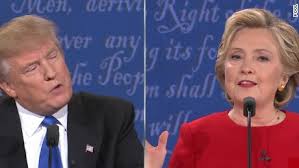 As articulated in Tuesday morning’s brief email note, the verdict of neutral observers after Monday evening’s US Presidential debate seems to be ‘Advantage Clinton’. And we grudgingly agree, even if our bottom line is that neither of these folks is qualified to be President. While we are not at all convinced that Secretary Clinton’s proposals on various fronts are the best way forward for the US and global economy, she won on points. That is due to sticking with the aggressive presentation of her program while she managed to accomplish her team’s goal of baiting Donald Trump into being reactive to criticism rather than pushing his vision after the first 20 minutes. The picture is indicative of a lot of what transpired. Mr. Trump actively either reverted to his jester role in response to various Clinton statements, or interrupted both her and talented, very balanced moderator Lester Holt to counter anything he felt was less than accurate (in his humble opinion.)
The second problem for Mr. Trump was his seeming inability to pounce on multiple openings where Clinton was vulnerable when the debate came around to topics like cyber security, nuclear proliferation, and so on. Obamacare’s burgeoning failure was never mentioned regarding the economic plight of the middle class. For anyone less than the most ardent Trump supporters this raised questions over whether he is able to keep in mind a full range of knowledge on key topics.
That would be a daunting weakness for any US presidential candidate; it is especially troubling for Trump in light of his claim that he understands more than almost anyone about all of the major issues facing the United States. If he has trouble connecting the dots for more effective responses on a limited number of topics in Monday evening’s debate, how much can the critical undecided US voters trust he will perform well in negotiations with other countries he has highlighted as essential?
Just to be clear, this is not an endorsement of the far more well-prepared Mrs. Clinton. Being somewhat conservative we would have preferred that Mr. Trump would have done better. Yet unless he can move beyond the rote talking points that serve him so well with his base, we are not at all convinced he should indeed be the next President.
Authorized Silver and Sterling Subscribers click ‘Read more…’ (below) to access the balance of the opening discussion. Non-subscribers click the top menu Subscription Echelons & Fees tab to review your options. Authorized Gold and Platinum Subscribers click ‘Read more…’ (below) to also access the Extended Trend Assessment as well.
NOTE: Back on the evening of December 8th we posted our major Extended Perspective Commentary. That reviews a broad array of factors to consider Will 2016 be 2007 Redux? For many who believe that the US economy is really strengthening and can once again lead the rest of the world to more extensive recoveries, this may seem a bit odd.
Yet there are combined factors from many areas we have been focused on since the early part of last year which are less than constructive for the global economy and equity markets. We suggest a read if you have not done so already.
We pointed out in December in the face of another likely Santa Claus Rally this was not an actionable view during the year-end equities rally. Yet it was (and remains) important background to utilize into 2016. This is much like our major late 2006 perspective on Smooth Rebalancing? …or… The Crash of ‘07? In that instance the economic factors built up, but the actual crash was deferred into 2008. It is starting to feel this one may be deferred as well.
▪ Because so much of the debate has already been dissected by the general and financial fourth estate, we will demure from too much further analysis. In any event, there are two more debates, and we are fairly sure that Trump’s team will be very pointed on his inability to win the election without some of the extensive preparation he eschewed on the way into the first one Monday evening. Secretary Clinton not only brushed up on her already extensive knowledge of government policy; she also planned and effectively executed traps for Trump, and well-honed responses to certain obvious Trump criticisms.
It is a given in US political analysis circles that any outsider needs to effectively express the advantages of their plans rather than just criticize the incumbent (and Clinton is a de facto incumbent.) There are two areas where Trump’s plan is likely more productive than what Clinton has to offer, yet she was able to characterize his corporate and personal tax reduction and regulatory reform plans as a return to ‘trickle down’ economics.
Lack of Qualification
As a further sign of both candidates’ lack of qualification for the job, her assertion that previous tax cuts were responsible for the 2008-2009 Crisis is nothing less than daft. Obviously she has not bothered to study the matter (at least watching the movie The Big Short) or understands what actually transpired, but is massively bending the truth to appeal to the Far Left part of her base inherited from the failed Bernie Sanders campaign.
Of course, Trump could not help but lower the financial knowledgeability bar even further by claiming the Fed (specifically citing Chair Yellen) as being politically corrupt in keeping rates low to the benefit of President Obama. Also daft. As was his next assertion that any modest increase in interest rates could burst the terrible stock market bubble this had created, and also raise the cost of US government debt service to an unaffordable level.
While the latter is indeed a concern, it would seem to militate against the Fed prematurely raising rates as he seems to imply it should have already done. And his entire assertion that the Fed’s motivation to keep rates low is to boost the stock market to the benefit of Barack Obama demonstrates an almost total lack understanding of the Fed.
Tax Reform
Yet there is one area where Secretary Clinton’s plans seem totally out of touch with extended and recent economic history, and Donald Trump knows of what he speaks:
Tax reform. One wonders what she could possibly be thinking, other than playing to her political base? As noted in our August 24th Fed-ticipation post, Trump’s plans at least have the potential to foment quite a bit of growth while Clinton’s are almost assuredly the path to further stagnation. The lack of real tax reform (i.e. lower corporate taxes) under Clinton is a problem that will also continue to plague the central banks that need a return to more robust growth in order to normalize monetary policy as well.
See last Friday’s Infuriatingly Academic post on the degree to which central banks not already pushing the political class on necessary structural reforms is a problem. And our previous August 24th Fed-ticipation analysis stands as a key difference in at least this area where Donald Trump offers a credible alternative; and Secretary Clinton’s approach is an unacceptable ‘more of the same’ (and in fact even quite a bit more.)
The balance of this opening section prior to the Extended Trend Assessment is the reproduction of the key sections of the August 24th post. We also strongly recommend a read of last Friday’s Infuriatingly Academic post for anyone who has not done so already. It articulates quite a few more reasons why the tax and regulatory reforms that the political class has studiously avoided are the real problem for central banks, and not the next minor incremental interest rate or Quantitative Easing decision.
From our August 24th Fed-ticipation post:
Four More Years?
So first we should consider what Secretary Clinton is proposing. We need to allow that she has been dragged to the Left by the success of defeated rival Senator Sanders. Yet her focus now is on more of the same we have seen in the Obama administration and more. To facilitate more government support (code language for government controlling more of the economy) she has been very clear that she intends to raise taxes and continue heavy regulatory intervention in the economy. Of course, that especially means the financial sector and energy businesses, etc.
Little focus has been provided to the impact of those measures on the economy. While it is a bit of a technical detail that many outside of the US (and even many residents) do not understand, taxing the ‘rich’ means taxing small businesses. That is due to the ‘pass through’ corporate structure that many small businesses use to consolidate the taxes under the business owner’s personal tax regime rather than pay separate corporate tax.
The problem for the broader economy is that small business is a driver for employment. And for the first time since records were kept more have closed than opened of late. So much for the success of the US economy in spite of the nominal job gains since the Great Recession that the Obama administration highlights. In spite of Ms. Clinton’s campaign promises of free college, higher Social Security payments and all manner of other goodies, the idea this will also create “more good jobs” is specious at best. Why would things that haven’t worked over the last eight years begin to work in 2017?
A Real Change
While he has softened his tone of late, there is rightful trepidation over whether an overconfident and bombastic Trump who has offended major groups along the way can possibly be a ‘unity’ President. We also need to allow that the Trump economic proposals have their flaws. Not the least of those is the concerns over whether his aggressive stance on renegotiating trade deals might trigger a global tariffs war. No small thing.
There is also the degree to which his seemingly productive tax reform plans would create an even larger US national debt through years of deficits. Of course, the latter depends on whether the US economy returns to more aggressive growth. The Fed would obviously appreciate that move into territory that would finally allow its wished for ‘normalcy’ to be more than just its bias. And as far as the budget deficits are concerned, they might be heavily mitigated by any growth that is more than many would project at present (even under a muted dynamic analysis.)
However, that better than expected growth is exactly what occurred under the Kennedy and Reagan tax reductions. Those turned out to be triggers for a virtuous circle of investment and hiring that outperformed any of the pre-tax cut projections. In spite of all the ‘jobs’ programs that have been instituted by government over the years and even massive monetary stimulus that has added many billions to the major central banks balance sheets, business capital investment has been the only major influence that brings about sustained economic growth.
This is why we have been so focused on the necessity of structural reform since early last year to reinforce all of the central bank efforts. We are now seeing that the central bank efforts on their own cannot restore anything near the pre-Crisis growth. While the Occupy Wall Street and other socialist movements would abhor allowing business to keep more of its earnings, along with regulatory reform that is likely the only path back to prosperity.
Repatriation and Investment
While Trump has not made a major point of it (at least not yet), consider the implications of his proposed 15% top corporate tax rate on the incentives for business on multiple levels. The first is whether that might entice corporate America to finally bring back some major portion of its Brobdingnagian holdings in offshore subsidiaries? In late 2015 that was estimated to be $2.1 trillion.
If memory serves us well, there was a reduced tax rate corporate profit repatriation regime in 1993 that saw many billions of US corporate holdings return home. While this distorted the US dollar, it was worth it. It would certainly help now under further assumptions.
Those would need to include the attractiveness of the proposed 15% top corporate tax rate on the incentives for business to invest the repatriated funds rather than just distribute them as dividends. If a company can keep that much more of what it earns, the ‘risk calculus’ on capital investment becomes much more attractive. In our experience, once one or two companies in a field begin expanding the rest feel they need to do the same to maintain a competitive footing.
Even beyond the tax rate, there would need to be some assurance of a regulatory rollback from the extreme regulation bloat of the past eight years. Along with healthcare reform to lower those costs from the now burgeoning (misnamed) Affordable Care Act expense, corporate America might renew its willingness to take risks on business expansion.
As an aside, this would also automatically eliminate the corporate ‘tax inversion’ domicile change incentives. With an average OECD corporate tax rate of 23% the efforts to punish those companies who want to leave the US (for the benefit of their shareholders) have only had limited impact on preventing the inversions. The lower proposed tax rate would likely entice some previous flight to reverse, and even attract foreign investment.
A Real Difference
The contrast is fairly stark. More of the same that has only allowed for mediocre growth in the US amidst a lackluster labor market is not an attractive alternative. While the headline BLS Employment reports have looked fairly upbeat, the slippage in US median income for the first time since WWII belies a slippage in middle class living standards. That is a big driver for the still less than compelling support for Donald Trump’s Presidential bid.
At least in the economic plans there is a real choice. While both candidates have more negatives than any US Presidential election at any time in memory, their personal and political foibles are not going to make much difference to the US economy. If some of the weaknesses in Donald Trump’s plans can be either mitigated (especially less contentious trade arrangement confrontation) or turn out to be more constructive (higher growth offsetting the potential budget impact of lower tax rates), then his is the better plan for a US economy that remains lackluster under the current higher tax and more expansive regulation regime.
[End of August 24th Fed-ticipation post excerpt]
Extended Trend Assessment is available below.
The post 2016/09/28 Commentary: Advantage Clinton appeared first on ROHR INTERNATIONAL'S BLOG ...EVOLVED CAPITAL MARKETS INSIGHTS.