2017/04/28 Commentary: Draghi, Dollar, Diametric (Again)
© 2017 ROHR International, Inc. All International rights reserved.
Extended Trend Assessments reserved for Gold and Platinum Subscribers
Commentary: Friday, April 28, 2017
Draghi, Dollar, Diametric (Again)
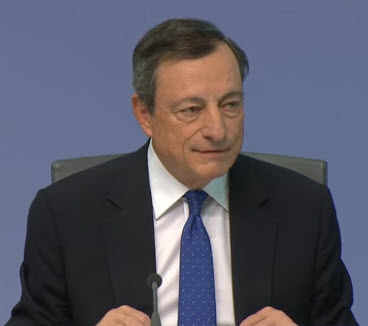 A very interesting thing happened at the European Central Bank (ECB) press conference Thursday: there were not any questions from the press on whether this month’s cut in the size of the ECB’s asset purchase program (its form of Quantitative Easing) was the beginning of a ‘taper’. It might seem to the uninformed observer that reducing the monthly securities purchase from €80 billion to a mere €60 billion does indeed represent a ‘taper’. Yet (as the single quote marks emphasis indicates) this is also a financial market central banking term of the recent era referring to the initial phase of a central bank terminating its major Quantitative Easing program. As such, it carries a connotation of the move to end that program, not just a reversible reduction in asset purchases if conditions warrant. Yet the latter is just what Signore Draghi has emphatically noted for months is the case for the current ECB QE reduction, as is also clearly stated in the ECB’s monetary policy statements.
Don’t take our word for it. Just go to Thursday’s ECB press conference opening statement (with links to the full press Q&A and video.) Previous ECB press conference transcripts can also be accessed, and all previous ECB press conference webcasts are also accessible at http://bit.ly/2pnguV7. And in general, it was fairly upbeat affair, even with the usual Draghi criticism of the lack of more aggressive structural reform which would reinforce the central bank’s accommodative monetary policy.
And he was very equanimical on some other topics, such as queries on how the ECB might be planning for political changes in Europe or the potential for shifts based on the programs proposed by the new US administration. His literal answer in one instance, and implied answer throughout, was the governing council discusses ‘policy’ not ‘politics’. Well said. Within that he allowed that structural reform is harder to pursue into the election cycle for obvious reasons, and that any major US reform success would need to be revisited once it is actually policy.
This is where we jump into discussing the US dollar, which has had split fortunes against developed economy and emerging currencies of late, with good reason.
Authorized Subscribers click ‘Read more…’ (below) to access the balance of the discussion. Non-subscribers click the top menu Subscription Echelons & Fees tab to review your options. As this is a concise ‘macro’ assessment and the Market Observations are much the same as Tuesday morning’s update in the lower section of Monday’s ‘HUUUGE! Redux’ post, there is no Extended Trend Assessment in this post.
NOTE: Given the likelihood the US economy will now get the structural reform that we (along with Mario Draghi and others) have been loudly complaining was not forthcoming since our dual It’s Lack of Reform, Stupid posts in January 2015, we need to adjust our view that a potential economic and equity market failure is coming. We previously referred you back to our December 8, 2015 post for our major Extended Perspective Commentary. That reviewed a broad array of factors to consider Will 2016 be 2007 Redux? While a continued regime of higher taxes and more regulation (i.e. under Clinton) might have fomented a continued weak or even weaker US economy, the tax and regulation changes proposed by a Trump administration that will likely be approved by the heavily Republican Congress now diminish the similar fears we had to what transpired in 2007-2008.
▪ And that focus on the greenback that had been stronger than not against the developed economy currencies until earlier this month and weaker against emerging currencies until the past couple of weeks. The US Dollar Index essentially topped out into early January. Yet in spite of trending lower, it was still holding the most key lower support into the 1.000-50 range. That had a Tolerance down to .9950, which was only Closed below very temporarily at the end of March.
Yet the recent combined strength of the British pound after the UK snap election announcement on April 18th, the euro’s recovery back above EUR/USD 1.0800-50 after last weekend’s centrist French election victory and the weakening of US economic data after the euphoric anticipation of better times to come on President Trump’s upbeat comments (and Treasury Secretary Mnuchin’s recently retracted aggressive tax reform promise) into March 1st has spelled trouble for the US dollar.
The only place where it has been overtly strong against a developed economy currency of late is the Canadian dollar, beleaguered due to the recent imposition of duties on its soft lumber exports to the US. Yet even there USD/CAD is only up to a marginal new 14-month high above the 1.3600 area late 2016 high, and the next interim resistance as nearby as 1.3700 area.
Emerging Currencies Reaction
Even the sharp reactions of emerging currencies on the fears over protectionism which flow from the Canadian tariffs are within the parameters of their overall up trends against the US Dollar. As a brief summary, even the very sensitive and volatile USD/ZAR has only reacted back up around the area of the recently Negated 13.30 weekly channel UP Break so far. And it has its own internal political reasons for weakening once again.
While USD/MXN has traded back above 19.00 congestion, the more meaningful trend resistance is up into the 19.35-.50 range. Even the Russian ruble that should also be weighed down by the sustained slide in Crude Oil prices has only seen USD/RUB rally to around failed 57.00 support (i.e. now resistance.) Recently range bound USD/BRL has only revisited the top of the past several months range at the 3.20 area failed major congestion support. And the Turkish lira has seen USD/TRY continue its slide from the early April retest of the 3.75-3.80 area to re-approach the top end of 3.55-3.45 support (last seen in late February) in spite of some concerns about its recent referendum’s impact.
Broader US Dollar Consideration
This is our segue into a brief consideration of the Trump Tax Plan previewed Wednesday afternoon by National Economic Council Director Gary Cohen and Treasury Secretary Steven Mnuchin. It was a very broad presentation, with the emphasis on tax reduction and enterprise encouragement. It would be futile to assess it here, as there has already been so much analysis of it in other publications and quite a bit of political assessment as part of that.
And much of it is also the criticism from those opposed to its lower tax and simpler system dynamics. Why anyone would be against simplifying such a Brobdingnagian and expensive system is beyond us. Yet we appreciate that there are also those who are adamantly against lowering taxes, because they are committed to the rich paying more even if that suppresses business development that would help the middle class as well.
We mentioned in our Wednesday morning’s Commentary: First 100 Days post that the geopolitical situation was reminiscent of the end of the Carter administration into the early Reagan years. And the fiscal and tax policies being espoused by each side also closely resemble that phase on the Obama to Trump transition.
In each case the new administration was elected in part on (and was/is dedicated to) its commitment to lower taxes and regulation in order to reinvigorate a US economy that had been dragged by higher taxes based on ‘fairness’ considerations.
That is in consideration that the ‘rich’ should pay more in a progressive tax system. This is reasonable, yet when overall levels get too high it is a disincentive for the corporate investment which can stimulate the economy as well. Corporate taxes always seem relatively easy to hike for the politicians on the Left, as they do not regard corporations as people. Yet they employ the people the politicians say they are looking out for, and those high corporate taxes create a weaker economy with fewer jobs.
Back Around to the Trump Tax Plan
It is not a major surprise that the bullish anticipation of the Trump ‘Tax Plan’ press conference Wednesday turned out to only a very anticlimactic ‘Tax Paradigm’. Which is to say it was not really a ‘plan’ so much as a broad blueprint of the sorts of things that the administration thinks will work in conjunction with each other to accelerate current, still modest US economic growth.
In other words, they have taken a ‘whack’ at what they think will work and can pass through Congress, with much still to be seen. And one of the criticisms even beyond the knee-jerk reaction of the Left that it is a giant gift for the ‘rich’ is that there is so much there, the administration will never get all of it through Congress.
Fair enough. Yet there are two key aspects worth watching as it regards the trend in the US dollar if and when any significant progress is made on tax reform. Aside from the overall economic strength, consider any attractive repatriation tax rate on the mammoth amounts of corporate profits that have been left offshore to avoid US taxation on the way back into the country.
The sheer economic strength will be the more important factor in the first instance. Any extensive acceleration of the still modest US growth (note this morning’s first look at US Q1 GDP and other recent weakish data) will be a natural attraction for capital from other countries where even recent somewhat improved growth is also still modest. As President Draghi noted in Thursday’s ECB press conference regarding the Euro-zone economy, the deflation risks may have been eliminated, but growth remains weak.
As such, any more extensive improvement in the US economy will be a magnet for inward investment, As we have noted on many previous occasions, this is what actually drives the longer term currency trends (versus shorter term trading.) And the lower rate will also satisfy a recent demand of the Left that companies not change domicile to avoid US tax rates. While the Democrats have passed quite a few bills and the Obama administration issued various executive orders to limit ‘offshoring’, the real solution is to lower the US corporate tax rate to levels than make any shift of domicile unattractive.
Preferred Repatriation Rate Wallop?
Even beyond that, quite a few Trump administration personnel have hinted at a preferred tax rate for repatriation of those massive corporate profits that have been stored offshore to avoid the high US corporate tax rate if they re-enter the country. Of course, the Left has already cited this as a gift to the rich. They overlook the degree to which many pension funds of the workers they say they are trying to protect are invested in the companies which are currently estimated to hold up to $2 trillion(!!) of profits offshore.
The Left is also thinking of schemes whereby some significant portion of those repatriated profits will need to be invested in corporate expansion or hiring as opposed to simply being distributed to shareholders. This is another half-baked government control idea whereby they think they can dictate corporate activity and have it end well.
What if the companies are not in a position where they need more workers based on their current structure and income? This will create temporary employment which will end as soon as the portion of the repatriated funds which were forced into those hirings is spent. Why not just let the companies enjoy the preferred rate and re-inject that $2 trillion into the US economy by whatever means they see fit?
Yet, regardless of whether there are some limited strictures (if they are onerous, the repatriation will not occur), any major repatriation incentives will definitely pack a wallop for the US dollar up trend. While this may seem a ‘blind flash of the obvious’, the extent and duration may be more than most observers expect.
So while we remain skeptical of the US dollar versus the other developed economy currencies for now, we will be watching the progress of the tax reform legislation closely for further signs a major repatriation is possible. If anyone doubts the degree of impact this may have, we refer them to 1992-1993.
The 1992-1993 History
1992 was the last time a major preferred tax rate for repatriation was proposed and then implemented into 1993. The US Dollar Index at that time was still composed of the constituent currencies of the euro that did not come into existence until 1999. Yet at that time the European economy currencies were also an even more major component of the US Dollar Index prior to the advent of so much trade with especially China along with other emerging economies.
The US Dollar Index hit the low of a bearish phase at .7819 in September of 1992, just prior to legislation authorizing the preferred tax rate repatriation being proposed, passing Congress by later than fall. By October it was up to .8763, and was up to .9250 by the end of the year. With all of that anticipation, further improvement that lasted through 1993 was more subdued. Yet it was still sustained up to the .9700 area into the end of the year, after which it gradually began a full year selloff that lasted through 1994 into early 1995.
And there was not really any particular reason the US economy should have been attracting sustained inward investment at that time to attract other currencies. It was in fact just coming out of the stubborn recession that cost George H. W. Bush the election on Bill Clinton’s observation that, “It’s the economy, Stupid.” And Clinton himself raised taxes to plug a deficit hole. Even though that underpinned the US economy, it did not do much to assist the US economy or equities.
Therefore, the only reason for that strong rally in the US Dollar Index was the sheer flow of currency back into dollars from other currencies in which the hoarded corporate profits were stored at that time. And we suspect a similar phenomenon will occur if another preferred tax rate for repatriation is approved in future. It might even be possible that the headline corporate tax rate falling to the 15% which is the Trump administration’s goal could foment some significant repatriation after many years up in the 35% area. Yet it is very clear that any rate much below 15% will likely trigger a repatriation tsunami.
Diametric (Again)
On an almost comical note, the Mexican government has figured out its response to overall dissatisfaction with the Trump administration’s proposed US southern Border Wall, and the US administration’s plan to have Mexico pay for it. In true circular firing squad fashion, it has threatened to impose an entrance duty on US tourists crossing the border into Mexico. It seems to be saying that it will get even with the US by burdening its own tourism industry. Could there be anything much more diametrically opposite to its own interests?
Evidently they are taking their cue from US Liberals’ knee-jerk reaction when they compared Trump’s proposed southern Border Wall to the Berlin Wall. It was not of any import for them that the US wall is proposed to keep people out, versus the East German government of the time having a pressing need to prevent folks from leaving for the more attractive West.
This would be funny if it weren’t a tragic indication of just how benighted much of the political class throughout the world can behave in pursuit of some sort of populist standing. This goes for some of the actions of the Trump administration as well.
▪ There is no Extended Trend Assessment in this post. This is a another concise ‘macro’ assessment, and the Market Observations on the Evolutionary Trend View for all markets remain much the same as Tuesday morning’s Market Observations update in the lower section of Monday’s ‘Commentary: HUUUGE! Redux’ post. Even the updated emerging currency observations above are (as noted) within the trend parameters updated on Tuesday morning.
Thanks for your interest.
The post 2017/04/28 Commentary: Draghi, Dollar, Diametric (Again) appeared first on ROHR INTERNATIONAL'S BLOG ...EVOLVED CAPITAL MARKETS INSIGHTS.