2017/06/21 Commentary: Equities Excess?
© 2017 ROHR International, Inc. All International rights reserved.
Extended Trend Assessments reserved for Gold and Platinum Subscribers
Commentary: Wednesday, June 21, 2017
Equities Excess?
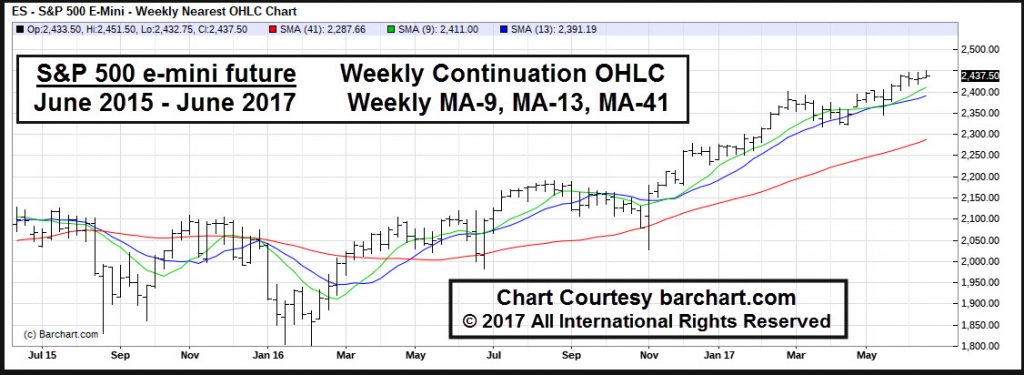 The US equities have had quite an upside run since Donald Trump’s somewhat surprising presidential victory in last November’s US general election. The central bank liquidity-driven rally had done very well since former Fed Chair Bernanke had taken the lead from NY Senator Chuck Schumer’s entreaty to “get to work Mr. Chairman” during Bernanke’s July 2012 Senate economic testimony. That was a reference to the fact the deadlocked Senate was not going to be able to compromise on any economic stimulus legislation. As the Republican House was opposed to the Barack Obama and Democratic Party continued heavy social spending, things were at an impasse.
As such, it was up to the Fed to continue and even expand its massive liquidity infusion Quantitative Easing (QE) program to prevent a slide back into weakness. The Fed’s action was considered excessive by some in following up on the very much needed post-Crisis March 2009 original QE program and its limited QE2 reinforcing that. Yet expansion into Summer 2012 nominally designated QE3 was considered so expansive by some that they termed it ‘QE Infinity’. This was in part a jest aimed at the Fed Chair having become like a lovable animated feature character, as ‘Buzz Lightyear’ Bernanke took the Fed balance sheet “to infinity and beyond” (a catch phrase from the feature Toy Story.)
Yet as the opening graph shows, the US equities rather liked the flows that derived from all the additional liquidity not being able to earn any ‘risk free return’ with interest rates also being kept down at negligible levels. The S&P 500 generally rallied from down in the 1,300 area after QE3 began in 2012 until it stalled into the 2,100 area by Spring-Summer 2015 prior to some sharp downside reactions. However, even after those reactions ended into early 2016, it still seemed stuck again at generally no better than the 2,100 area prior to the US election. Then there was the Trump election, which triggered all manner of positive expectations on various reform and stimulus prospects.
Yet within that context, it is possible to consider US equities might be overpriced now if the Trump agenda does not manage to get passed into law...
Authorized Subscribers click ‘Read more…’ (below) to access balance of the discussion. Non-subscribers click the top menu Subscription Echelons & Fees tab to review your options. As this is a ‘macro’ assessment, Market Observations remain the same as the past weekend’s update (lower section) of Friday morning’s Commentary: FOMC: All Options Open post, and there is no Extended Trend Assessment in this post.
NOTE: Given the likelihood the US economy will now get the structural reform that we (along with Mario Draghi and others) have been loudly complaining was not forthcoming since our dual It’s Lack of Reform, Stupid posts in January 2015, we need to adjust our view that a potential economic and equity market failure is coming. We previously referred you back to our December 8, 2015 post for our major Extended Perspective Commentary. That reviewed a broad array of factors to consider Will 2016 be 2007 Redux? While a continued regime of higher taxes and more regulation (i.e. under Clinton) might have fomented a continued weak or even weaker US economy, the tax and regulation changes proposed by a Trump administration that will likely be approved by the heavily Republican Congress now diminish the similar fears we had to what transpired in 2007-2008.
[Thanks again to barchart.com www.barchart.com for the graphic.]
▪ We have been very pointed in our consideration of the importance of the Trump reform and stimulus agenda as a key determinant of whether the extended US equities rally is indeed reasonable. The operative question is whether they are properly priced at current and ultimately potentially even higher levels. If the Congress can manage to actually pass the Trump/Republican legislative agenda (healthcare and tax reform and infrastructure spending stimulus) into law, there is a real case for attendant acceleration of the US economy. That would in turn create the sustained corporate earnings growth that would support current and even higher equities valuations.
However, if not, then the opposite case of equities being overpriced at present (much less at higher levels) is a reasonable concern. And prior to getting into the insights from a very credible source, we need to be clear that this is not some ‘special alert’ on any imminent threat to the current US equities rally. While any correction on the legislative effort failure might be rather substantial, that equities psychology driver will not be apparent until at least later this Summer. Only if the significant legislation in various areas appears to be failing by the time of the US Congress August recess (pretty much the entire month until returning after Labor Day) will things begin to appear more dire.
In the meantime the hope it will succeed along with already constructive Trump rollback of so much of his predecessor’s executive order regulatory regime should provide a very constructive influence. And that positive psychology will reinforce already positive flows into US equities based on technical financial factors (more below.)
As a bit of context for that, when we became suspicious of the US equities bull market at the end of 2006 we also cautioned that the Evolutionary Trend View remained bullish in the near term. At least that’s what we explored in our Capital Markets Observer II-48 “Smooth Rebalancing? …or… The Crash of ’07?” (December 6, 2006) along with considerations on the Fed, US Housing and other factors. The first few pages are the key view on how the equities were indeed already entering a distended bulge that would become a bubble into the higher levels we allowed were likely.
Yet even as weaker US housing indications began to emerge in early 2007, a still very accommodative Fed and the equities’ ability to attract buyers on selloffs had maintained the extension of the up trend. By June the front month S&P 500 future had pushed up from March reactions below 1,400 to the mid 1,500 area. That was the point at which we reminded those who were questioning our broader negative view that bubbles could feed on themselves until something came along to burst the extended psychology.
It was at the time we included in our research and even had a blog post the FT’s LEX column was kind enough to publish on why it was still necessary to “Learn to love the bubble.” Much as we are asserting at present, while there can be “various indications the markets are ‘overbought’ (often to the frustration of proponents [that the market is overbought]), some sign they are actualizing that potential requires a failure below technical or psychological price support.”
And as we have focused on for some time regarding the US President getting in the way of his proposed reforms, we suspect the state of the Trump reform and stimulus agenda into late July will be a key overall equities trend influence. As far as any technical price activity failure, it is too early to tell how that pattern might occur later this summer. Back in 2007 it was a mid-July S&P 500 front month future weekly pattern UP Break above 1,550 area that had failed by late month triggering the initial sharp selloff into mid-August.
Trend Evolution Note
As a further note on the actual overall trend activity, the broad trend in the opening S&P 500 front month future weekly continuation chart had advanced markedly from around the 1,300 area from the time QE3 was instituted. Yet even the renewed bullish tendencies from March 2016 into the November US election were stalled into not much better than the previous highs around the 2,100 area.
As is glaringly apparent, the anticipation of improved economic activity based on Trump reform agenda promises took over the psychology right after November’s US election. That was for the initial late 2016 rally to the 2,270 area, followed by the quasi-euphoric swing up to the 2,400 area into March 1st on Trump administration reform and stimulus announcements prior to some problems creating a reaction.
Yet right now the classic ‘Sell in May and go away’ seasonal cliché is also obviously not working this year, as the US equities pushed above the previous 2,400-05 March and May front month S&P 500 future highs immediately on June 1st. As noted in all recent Market Observations, that has left the interim 2,430-25 area congestion (hit again in overnight electronic trading into today) and more prominent 2,405-00 range as key lower supports.
Rosenberg
And every time the market holds a near term selloff (just like early 2007), it is even more likely that both the technical and psychological aspects might not become more critical until later on in July (as noted above.) Yet there was some further insight on how far in front of reality the US equities might be in a series of CNBC segments on Tuesday.
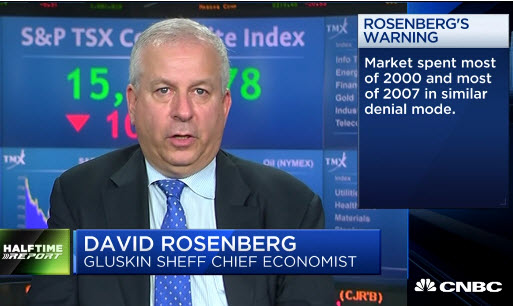
Those were with Gluskin Sheff Chief Economist and Strategist David Rosenberg. We have been a fan of Rosenberg since he was a kindred spirit on US equities doubts out of 2007 into all of 2008. Like all analysts, he is wrong at times. Yet his insights on the ‘macro’ situation and adherence to respecting it have always been impressive, and prescient at times in opposition to the ‘received wisdom’ of The Street. In the first CNBC segment he mostly asserts that what many feel is a bubble in the bond markets is simply the bonds reflecting the reality of a lower growth path than dictated by upbeat anticipation.
In that we have been on the same page for a while, as we have noted the recent serial weak US economic data well into Q2 that is inconsistent with the anticipation from late last year into early this year. This and all the rest we are about to relate get back to the importance of the success of the Trump reform agenda if the current, and future higher, equities valuations are going to be justified.
In the second CNBC video segment (pardon the brief commercials at the beginning of each of these) he rebuts the now ‘received wisdom’ future growth estimates from the CNBC host. He cites the New York Fed just having lowered its US Q2 GDP estimate to 1.9% and Q3 down to 1.5%, which he notes a bit later is what used to be referred to as “stall speed” rather than the 3.0+% the Trump administration is projecting.
When asked about other respected individuals saying things are ‘good’, he asks what their definition of good might be? He cites US Housing Starts and automobile sales both down for the past five months, and restaurant sales (which is a bellwether for Consumer Discretionary Spending) being down for each of the last four months. Of the major 16 major economic indicators released in the past five weeks, only one managed to come in above estimate.
US Equities in Denial
There is also a graphic which displays briefly in this segment that points out the US equities were in denial at overly bullish levels through 2000 and 2007. This is all part of the reasons for the fund flows continuing to support the US equities (much like 2007.) He is very pointed on valuations in the third CNBC video segment, more specifically explaining the extent of the overpricing of the US equities.
Compared to reported earnings the price multiple is now 24. That was only higher one time, at 33 during the 1999 Dot.Com Bubble. At 24 it is already 20% higher than at previous peaks outside of that 1999 aberration. It is already above the peak multiples prior to the 1987, 1990 and 2007 tops. As such, he is skeptical of those who propose that there is going to be multiple expansion as a means to justify an overall higher US equities trend.
His view is that this is a liquidity and fund flow driven market. This is primarily supported and exacerbated by the funds flowing into leveraged ETFs, with many ‘investors’ very comfortable with passive index buying. This is why he is not bearish on the entire market, as financial companies should benefit from the gradual rise in interest rates and reduced regulation. Yet in general he feels the US equities are overvalued, including the highly favored technology sector.
[Anyone wishing to see all four Rosenberg discussion segments should CLICK HERE and search the term ‘Rosenberg’.]
Not a Major Crisis Looming
This does not portend the sort of global economic weakness seen during the 2007-2008 Crisis however, as he likes Japan and continental Europe; especially the German economy that is firing on all cylinders once again.
As such, any skepticism toward the US equities should be constrained to reflect the ‘over valuation’ right now if the Trump reform and stimulus agenda are not faring well later this Summer. Once again referencing the opening front month S&P 500 future weekly continuation chart, barring any catastrophic fundamental-economic impact, there should be quite a bit of support back into all of the 2015-2016 congestion prior to the post-US election extended rally. Of note, a classic full trend correction points to a target of roughly 2,200-2,100 satisfying a 10%-15% correction from the current 2,450 area trading high.
While corrections often either undershoot or overextend that classic 10%-15%, it is interesting that the low-mid 2,100 is the trading area reflecting the strength of the US equities prior to any more extensive growth expectations due to the Trump reform and stimulus anticipation. As such, it would be reasonable to expect that might be roughly the worst the US equities would perform if the Trump agenda overvaluation were eliminated.
We shall see.
▪ There is no Extended Trend Assessment in this post. This is a ‘macro’ assessment. In spite of the short term impact of various matters reviewed previous, Market Observations on the Evolutionary Trend View (available to all Gold and Platinum subscribers) for all markets remain the same as those in this past weekend’s update (lower section) of Friday morning’s Commentary: FOMC: All Options Open post.
Thanks for your interest.
The post 2017/06/21 Commentary: Equities Excess? appeared first on ROHR INTERNATIONAL'S BLOG ...EVOLVED CAPITAL MARKETS INSIGHTS.