2016/02/05 Commentary: FOMC – MPC Battle?
© 2016 ROHR International, Inc. All International rights reserved.
Extended Trend Assessments reserved for Gold and Platinum Subscribers
COMMENTARY (Non-Video): Friday, February 5, 2016
Commentary: FOMC – MPC Battle?
 Let’s allow from the outset that this is not a UFC (Ultimate Fighting Championship) cage match. There won’t be a knockout decision that leaves one contender victorious and the other vanquished. However, insofar as it is possible either the US Federal Open Market Committee or the Bank of England's Monetary Policy Committee could end up bloodied once this difference of opinion on the impact of a weaker global economic situation is resolved. It is especially interesting that the equities are weakening after this morning's US Employment report indicated weaker than expected growth in Non-Farm Payrolls. Within the current ‘bad news is good news’ equities psychology based on more accommodative central banks (BoE included), 40,000 fewer than estimated US jobs created in January might have been bullish.
However, two other key components of the overall US jobs report are considered to be a major reinforcement for the Fed's tightening stance. While recent weak economic data seem to fly in the face of that tightening instinct, this morning’s better-than-expected Hourly Earnings along with the Unemployment Rate dropping to 4.90% (lowest since February 2008) seems to have at least partially reinforced the FOMC's perspective.
That said, the US Bureau of Labor Statistics of the Labor Department always applies a significant ‘seasonal adjustment’ to these numbers. That leaves room for major revisions like last month's downgrading of the headline jobs number from a gain of 292,000 down to 262,000; and it could drop further on the final revision next month. Yet for now, higher long-term government bond yields coming along with the weakness of equities today would seem to speak of real-time concerns about the Fed's future actions. All of which is not just contrary to the Bank of England's view, but also the far more accommodative perspective assumed lately by the ECB and Bank of Japan.
So in the context of the significant weakness in much of the rest of the world, which perspective is going to dominate?
Authorized Silver and Sterling Subscribers click ‘Read more…’ (below) to access the balance of the opening discussion. Non-subscribers click the top menu Subscription Echelons & Fees tab to review your options and join us. Authorized Gold and Platinum Subscribers click ‘Read more…’ (below) to also access the Extended Trend Assessment as well.
Misguided Fed?
To paraphrase the late Ronald Reagan, “There they go again!” The FOMC Statement last Wednesday cited all manner of good reasons why this may not be the time to withdraw accommodation. Yet it also included language confirming their belief that inflation will “…rise to 2 percent over the medium term as the transitory effects of declines in energy and import prices dissipate and the labor market strengthens further.’ You can see the highlights of the FOMC statement in our marked up version.
That is code language (although not at all well-disguised) which speaks of a Fed still suffering from ‘normalcy bias.’ That leaves it hoping everything it has done so far is enough to get back to higher rates. Hence in its typical perverse manner during a ‘bad news is good news’ phase, the market (i.e. equities) not liking anything which tends to reinforce the argument of the hawks on the Fed.
Yet as we noted in our December 16th Commentary: Fed’s ‘Normalcy Bias’ Continues right after the first rate hike in almost a decade, the Fed had probably missed the right timing to raise rates back in late 2014. We also had explored this topic at some length in our Will 2016 be 2007 Redux? post back on Tuesday, December 8th. That explored the many reasons why headwinds will be strong enough to present significant challenges to the global economy and equities in 2016. And at least so far the equity markets seem to at least agree whenever there is a reason to feel the Fed might be tightening; and perversely rally whenever the data weakens enough to forestall any aggressive tightening.
Been there, done that
Last Wednesday’s statement is reminiscent of the Fed stance at the mid-September FOMC announcement and press conference. Equities’ response to their lack of a rate increase then being accompanied by that particular phase of misguided ‘normalcy bias’ (in place since early 2015) was a bout of extensive weakness into the end of the month. Hinting at raising rates during and after that meeting, while citing many of the same reasons for circumspection we saw on Wednesday, fomented a $150 drop in the S&P 500.
Yet, there was then a classical ‘prismatic’ shift in the impact of market psychology on the Evolutionary Trend View (ETV.) The economic data going from bad to worse into early October (remember that abysmal October 2nd US Employment report?) inspired an extensive rally (which we anticipated.) That carried above the mid-September FOMC front month S&P 500 future high at 2,020; and it pushed above it shortly after the October 8th release of the mid-September meeting minutes. So it was back to ‘bad news is good news’ on the renewed skepticism the Fed would raise rates in October. Sound familiar?
And there is a very good reason the equities have been able to rally since the Wild Wednesday Wobble two weeks ago; and that once again marginalizes the Fed’s quasi-hawkish stance. While those other factors are important, there are indeed also additional pressures on the Fed to demure from further rate hikes. That has to do with the ever more obvious weakening of the US economy as part of globally weak data last week into this week.
Yet there is a real, far more telling difference between now and last September…
Other central banks
Back in September quite a few of the world’s other central banks were also taking an upbeat stance that was the complement to the Fed’s ‘normalcy bias.’ The ECB was expressing confidence that its QE program had accomplished quite a bit, even if inflation was still at depressed levels. It rightfully pointed to the narrowing of lending spreads between core Europe and the previously distressed periphery.
The Bank of Japan was similarly attempting to sound more confident last fall. It even went so far as to deliver Draghi-style disappointment at its December 18th meeting by failing to expand its QE program as some had anticipated. Of course, both of those banks have now been through a total volte face since the top of this year. That is due to the extreme weakness of the energy and commodity markets that is feeding through to weakening of inflation data and confidence factors.
So while the Fed might still be alluding to serial rate hikes this year (even if the timing is indeterminate) due to being stuck with its ‘normalcy bias’, the central banks with more depressed economies and lower inflation rates are having none of it. And as money is fungible, there quantitative easing and extended accommodation is acting to significantly offset equity market fears over any tightening liquidity threat.
BoE joins the party
Even if in a far more subdued maintenance of accommodation rather than moving toward a more aggressive rate cuts or resuming Quantitative Easing (QE), the Bank of England is now content to err on the side of continued low base rates. This leaves it more so in line with the continued aggressive accommodation from the ECB and the BoJ.
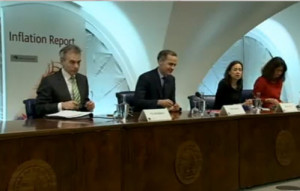
Thursday's Inflation Report press conference was very illuminating on how the central bank can remain vigilant while not threatening base rate increases based on some future expectation for either employment or wages. While the opening Statement was interesting, as always the financial reporter Q&A gets to the more critical topics.
And one of the key sources of concern even within the weaker recent UK Employment tendencies was the growth of wages. In addition to Governor Mark Carney's answers in that area, the clarifications from Deputy Governor Ben Broadbent were very enlightening. He noted that Average Weekly Earnings were always in flux, it was very important to also note the degree to which that is an additional cost for business. That indication also had to be combined with Hours Worked that can offset some of the impact of higher wages.
The more major influence from Average Weekly Earnings is also any sustained trend, as that begins to affect inflation expectations as well. This is something that the Bank will be watching closely as the National Living Wage impacts the figures, yet that has already also been accounted for in the future projections.
Bank’s effective view
As opposed to what we have considered a somewhat misguided view from the Federal Reserve in recent months, the Bank of England has taken a far more balanced approach to the interest rate and economic outlook. That said, we need to allow that it was not struggling with the previous ZIRP (Zero Interest Rate Policy), and also can allow for a greater impact on the UK economy from international economic developments and other influences. However, its overall approach still seems more rational in the context of what indeed has become a much weaker global economy than even last fall.
Even considering domestic UK developments, Mr. Broadbent was very pointed on not just focusing on the sheer employment statistics. Both he and Governor Carney noted that it was just not wage changes or sheer expansion of employment that was important. It is critical to also note the type of jobs that are being created. Might they please ring up Janet Yellen and the other Federal Reserve Governors to share that bit of insight?
US misread
It is one of the real problems with any return to robust growth in the US economy that so many high-paying construction and manufacturing jobs have been replaced with folks being forced to accept HES employment. That acronym refers to Hospitality, Entertainment and Services employment. Many highly regarded sources that we have referenced in our previous observations agree on this: There has been a ‘hollowing out’ of the US middle class, with commensurate lower spending power that shows up in a lot of the statistics outside of the sheer employment numbers.
And as was seen in the most recent Challenger Job Cuts numbers for the US yesterday, those were up 218% to 75,114. And the major losses outside of the Energy Sector were in Retail. While in many years this could be attributed to the cyclical layoffs after the end of the holiday shopping season, January 2016 was still 42% higher than 2015. It was also the highest number of retail layoffs since January 2009 at the height of the financial crisis.
The problem with the US relying on the services sector that also saw such an abysmal PMI on Wednesday is that this represents more of a secular change than previous years. It is all part of the move to a much greater classical retailer reliance on e-commerce than anything seen previous. As the success of Amazon has pressured margins and other major retailers like Walmart, permanent closures of retail shops is going to continue the pressure on employment in this major sector.
Additional BoE signals
When asked about the effectiveness of the Bank of England's comments in moving rates without the Bank necessarily needing to do anything, Governor Carney noted that the Inflation Report press conference would continue to do just that; along with other interim communications. He also noted that major external shifts like the Scottish independence referendum or even more substantial Brexit (UK leaving the European Union referendum) could not be overtly incorporated into the Bank’s analysis. They always had to assume the status quo would prevail, until it doesn't.
That said, he noted that the bank was able to incorporate the extended influence as it showed up in the pricing of various market instruments. There was also any overt impact on either household or business confidence or willingness to borrow. And as to the horizon for any rate increase, he was clear that the overriding sentiment in the Monetary Policy Committee was that rates will be going up at some point rather than heading lower. However he was also clear that there was no predetermined action plan based on future anticipation: they are fully data dependent, even if they believe the disinflationary influences will dissipate across time into early 2017.
We hate to be self-critical on behalf of the US central bank, but this seems a far more rational and incrementally reasonable approach than the anticipatory view of the FOMC at a time when there is still so much weakness and little chance of rampant inflation.
Conclusion
Top line of the conclusion is that there is a confluence of factors that are less propitious for the continued growth of the global economy than the powers-that-be in the US would like the masses and investment classes to believe. The bottom line is that all of the talk of returning the world to levels of inflation that speak of the need to invest have put the cart far out in front of the horse.
And over the later portion of the current cycle the US has been the worst offender. That goes back to the mid-2012 directive from Senator Schumer to then Fed Chairman Ben Bernanke to, "get to work Mr. Chairman.” That was on the assumption that the US political class was so acrimoniously partisan that the normal fiscal, regulatory and tax reforms that were part and parcel of previous robust recoveries were not going to be forthcoming. And unfortunately Bernanke took the bait and instituted QE-3 (also known as QE-Infinity.)
So while the political class roundly condemns corporate inversions like the recent shift of Midwest manufacturing success story Johnson Controls over to Ireland, the entire debate has shifted away from doing anything about reforming the key areas of the US industrial policy. This is why the central banks actions can infuse enough liquidity to float risk assets, yet will not create the real growth that everyone desires. In that regard, pending a more constructive contribution from the political class to improving individual economies and the global situation, the MPC would seem to be acting in a far more reasonable manner than the FOMC.
Extended Conclusion is available below
The COMMENTARY Extended Trend Assessment is accessible below.
The post 2016/02/05 Commentary: FOMC – MPC Battle? appeared first on ROHR INTERNATIONAL'S BLOG ...EVOLVED CAPITAL MARKETS INSIGHTS.