2016/02/19 TrendView VIDEO: Global View (early)
© 2016 ROHR International, Inc. All International rights reserved.
The analysis videos are reserved for Gold and Platinum Subscribers
TrendView VIDEO ANALYSIS & OUTLOOK: Friday, February 19, 2016 (early)
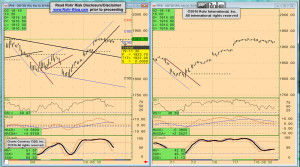 Global View: All Markets
While we can appreciate there are ‘bad news is good news’ phases for equities, it seems of late this has evolved into ‘abysmal news is good news.’ While that might seem a bit odd, it is completely reasonable under the current circumstances. That is due to the concerns over the US Federal Reserve monetary policy being out of synchronization with the other global central banks. As we noted in last week Tuesday evening’s Commentary: Fear & Loathing in Marketland post, there were concerns that the Fed was going to continue to raise rates into a weakening global economic situation. That was brought home to roost in Thursday morning’s release of the OECD’s Economic Outlook Interim Report showing further weakening of global economic growth in 2016 and into 2017. While there is much else to review in that regard and the other serial weak (bordering on ‘abysmal’) economic data this week, we will be posting a separate Commentary on that later today.
Suffice to say for now that this is having the effect of encouraging the equities through fresh perceptions the FOMC might be constrained to limit (or even eliminate) any further planned rate hikes that would have been part of its ‘normalcy bias’ (see our December 16th Commentary Fed’s ‘Normalcy Bias’ Continues for more on that.) And a bit of a capitulation occurred Thursday morning when normally hawkish St. Louis Fed President James Bullard is now saying it would be ‘unwise’ for the Fed to raise rates further in the current environment. That fit in with Wednesday’s FOMC minutes showing a bit more dissent on future hikes than Janet Yellen’s Congressional testimony might have indicated.
_____________________________________________________________
Video Timeline: It begins with macro (i.e. fundamental influences) mention of aspects noted above, and the degree to which data remained weak on balance through all of last week right into this week (except a few bright spots.) That was especially so for very weak Australian Employment, the US Philly Fed and Japanese Department Store Sales.
It moves on to S&P 500 FUTURE short-term at 02:45 and intermediate term view at 07:00, with OTHER EQUITIES from 091301:15, GOVVIES beginning at 13:45 (with the BUND FUTURE at 17:30) and SHORT MONEY FORWARDS from 20:15. FOREIGN EXCHANGE covers the US DOLLAR INDEX at 22:45 EUROPE at 24:15 and ASIA at 26:30, followed by the CROSS RATES at 29:45 and a return to S&P 500 FUTURE short term view at 32:45. As this is an especially extensive analysis due to our desire to review the impact of the weaker economic data and central bank influence at some points, even more so than usual we suggest using the timeline cursor to access analysis most relevant for you.
_____________________________________________________________
Authorized Gold and Platinum Subscribers click ‘Read more…’ (below) to access the balance of the opening discussion and TrendView Video Analysis and General Update. Silver and Sterling Subscribers click ‘Read more…’ (below) to access the balance of the opening discussion.
NOTE: Back on the evening of December 8th we posted our major Extended Perspective Commentary. That reviews a broad array of factors to consider Will 2016 be 2007 Redux? For many who believe that the US economy is really strengthening and can once again lead the rest of the world to more extensive recoveries, this may seem a bit odd.
Yet there are combined factors from many areas we have been focused on since the early part of last year which are less than constructive for the global economy and equity markets. We suggest a read if you have not done so already.
We pointed out in December that in the face of another likely Santa Claus Rally this was not an actionable view during the year-end equities rally. Yet it was (and remains) important background to utilize in 2016. This is much like our major late 2006 perspective on Smooth Rebalancing? …or… The Crash of ‘07? (even though the actual crash was deferred into 2008.)
▪ This all reminds us of last September into October. After the mid-September FOMC meeting and Chair Yellen press conference the equities were under sustained pressure into the end of the month. This was once again due to the Fed’s indications things were ‘normalizing’; and back at that time its ‘normalcy bias’ was also maintained even after the US data also weakened. In spite of all the incoming weakening economic evidence, various members of the Fed’s extensive minions restated it was going to raise rates into that weakening global economic situation.
However, the economic data was so weak by the end of September that the equities actually began to stabilize. And then a funny thing happened: right into the very beginning of October, the weak data encouraged the equities on the major ‘prismatic’ psychological shift into an ‘abysmal news is good news’ market. And we revert to that terminology again because nothing could have been more abysmal than the early October US Employment report showing a gain of only 142,000 jobs in September versus a 203,000 estimate.
The December S&P 500 future response? Open and trade more than $30 lower into 1,883, yet recover to post a $26 higher Close at 1,943. And of course, that initiated the entire late year rally that carried back up into the 2,100 area.
▪ We do not necessarily believe the current rally can do anywhere near that well, as the global situation is a lot less hopeful than it was back into the end of last year. And while we will have more to say on the deterioration of the fundamental situation soon, it is more important this morning to revisit the key market tendencies.
The March S&P 500 future ability to recover back above the major 1,865-60 area was very important. Tuesday’s ability to post an 1,886 UP Break out of its short-term trend channel resistance was also telling, as it encouraged a push above 1,895-1,902 resistance all the way into the 1,925-32 range. However, it does appear to be stalling now, with the aggressive near term up channel support 1,922 DOWN Break as near term resistance.
If it can hold and push above 1,932, next resistances are into 1,950, 1,958-62 and the more prominent 1,970-75 area. However, if it drops from here, it is more likely rolling over for a test of the lower supports at the violated resistance areas noted above.
Of course, we knew all of the negative fundamentals would be a positive backdrop for the GOVVIES in spite of their weakening from the extreme highs of the ‘haven’ bid squeezes into last week Thursday. As noted in the Market Observations which were updated in Wednesday morning’s Concise Highlights (below the video analysis), GOVVIES also like the ‘bad news.’ While they were under a bit of pressure into early this week, the recently violated resistances like MARCH T-NOTE FUTURE 130-00 and MARCH GILT FUTURE 121.00 were not even tested. MARCH BUND FUTURE did not Close back below the relatively elevated weekly oscillator threshold at 164.35 again prior to beginning to push higher again.
As such, they all appear to be maintaining aggressive up trends. As they were all reacting more so to the EQUITIES recovery than any major strong data on their recent selloffs, the decision by the EQUITIES will likely be telling for the fixed income as well.
And the FOREIGN EXCHANGE remains a more convoluted affair, with the US DOLLAR INDEX reacting to the various central bank moves. Yet it is also still weak below its recent .9860 DOWN Break even if it held interim .9550-00 support for now. That is consistent with EUR/USD pushing back above 1.1000 area previous DOWN Break and its 1.1120-50 Tolerance, yet still not getting up to the mid-upper 1.1400 area.
The one striking development is the USD/JPY major monthly up channel 116.20 DOWN Break that has already seen it trade below interim Fibonacci and congestion support in the 113.00 area. Yet, more major historic congestion is not until the 110.00-109.00 area, with the more recent heavy congestion in the 105.00-101.00 range from the way up in May 2013 through October 2014.
The TrendView VIDEO ANALYSIS & OUTLOOK is accessible below.
The post 2016/02/19 TrendView VIDEO: Global View (early) appeared first on ROHR INTERNATIONAL'S BLOG ...EVOLVED CAPITAL MARKETS INSIGHTS.