2015/10/22 Commentary: Draghi drives disinflation psych (late)
© 2015 ROHR International, Inc. All International rights reserved.
Extended Trend Assessments reserved for Gold and Platinum Subscribers
COMMENTARY (Non-Video): Thursday, October 22, 2015
Commentary: ECB press conference
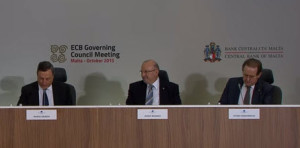 It is probably not much of a surprise that Mario Draghi was very pointed on the continued risks of disinflation (as opposed to outright deflation.) He had some help from others at this particular meeting in Malta (more below), and even went beyond what some might have expected. While that did not include any commitment to an expanded ECB Quantitative Easing (QE) program at this meeting, he left little doubt that it was a possibility based on how economic circumstances evolve. Yet there was little doubt regarding the impact on the markets.
Whatever might have been vexing the US equities late Wednesday, it was a clear example of “The Agony and the Ecstasy” (with apologies to Irving Stone for coopting the name of his book once again) as Wednesday’s weakness retesting 2,015-10 support turned into a $15 higher December S&P 500 future gap opening that led to trading up to $24 higher by the end of the first half hour. In the context of continued major central bank accommodation, the ‘bad news is good news’ psychology is still driving the equities rally on what has been miserable economic data and even weak corporate earnings without inflicting any pain on the govvies. After all, for the latter ‘bad’ news is usually ‘good’ news. The euro weakening as well was a sideshow in a ranging Foreign exchange market.
In any event, the concise topical review of the full ECB press conference is explored below. For anyone who is interested, you can also review the full video of the press conference and the transcripts of the opening statement and Q&A. While there was no real ‘news’ today, the extensive review and renewed commitment to all of the monetary tools the ECB has at its disposal and is eminently ready to use was impressive; possibly even more so than the previous focus on the incremental initiation of each of these methods.
It was a tour de force of a central bank still focused on “whatever is necessary.”
[For anyone who missed the earlier notification, there was an update of the current Market Observations prior to the ECB press conference added to Wednesday morning’s Global View TrendView post. Those current market comments are still the relevant view, and can be found below the video for all Gold and Platinum echelon subscribers.]
Authorized Silver and Sterling Subscribers click ‘Read more…’ (below) to access the balance of the opening discussion. Non-subscribers click the top menu Subscription Echelons & Fees tab to review your options and join us. Authorized Gold and Platinum Subscribers click ‘Read more…’ (below) to also access the extended trend assessment as well.
Disinflation
Energy prices remaining mostly low are a continuing disinflationary factor. As the opening statement noted, the Euro-zone inflation for August dropped into mildy negative territory once again, and energy prices along with commodities weakness are the culprits. Brian Blackstone of the Wall Street Journal can always be counted on for telling questions, and he wanted to know why the ECB was fighting so hard to raise inflation to higher levels when so many lower-middle and lower class individuals benefit from lower prices?
Signore Draghi responded that the very low inflation was a drag on debt service that remains a critical issue for debt-burdened individuals and governments in the Euro-zone. However, he then got a major assist from ECB Vice President Vítor Constâncio. He noted the extensive academic studies that had established there was a ‘measuring’ problem with inflation: it is often overstated in official statistics. It is the case that the risk of a downside error is always greater than underestimating inflation.
He also waxed eloquent on a topic related to that heavier debt service burden: the lower the nominal inflation, the higher the effective interest rate is in fact. While the ECB official base rate is a paltry 0.05%, with a nominal monthly inflation rate of -0.10 there is actually a positive ‘real yield’ that is especially a burden to debtors in a slow economy.
Economic weakness
The other factor that is keeping the ECB so accommodative is the desire to head off any external weakness seeping back into the European economic psychology. China is more so a concern on the ‘confidence’ factor than other fronts (direct and indirect export channels and financial flows), as long as its GDP growth maintains at the 6.0% discussed at the recent Lima IMF meeting. The greater risk is from Emerging Market economies being so stressed. The complete shutdown of a single export channel might present more of a risk than somewhat weaker Chinese performance.
Endless QE??
The other part of the question from WSJ’s Brian Blackstone was on the potential for endless QE, where he referenced the experience of the Fed. Signore Draghi addressed that with a restated commitment to the program’s full implementation through September 2016. That was the confidence factor as well on not disrupting expectations now that the program is beginning to have an effect. In that regard he noted that commercial lending was beginning to loosen up, and that the spread between previous premiums on peripheral Euro-zone corporate lending rates and the core was narrowing. While he allowed that it could be adjusted if conditions changed, that was not a consideration now.
Negative rates possible?
Then in one of the truly aggressive statements, even if he had mentioned it in passing previous, he noted that a drop into negative rates was possible after a year of the effective Zero Interest Rate Policy (ZIRP.) He allowed that both this and a further lowering of the Deposit Facility Rate WERE discussed at today’s meeting. This is pretty radical stuff, and just the sort of thing that gave the equities their extra boost prior to the US Regular Trading Hours opening at 08:30 CDT. If you do not just institute a true ZIRP, but also lower a rate that would push the banks to lend more, THAT is real stimulus.
QE implementation
In response to a question he noted that the ECB QE program had not run into the feared ‘eligible bond’ scarcity that was a concern on the way into the program due to the smaller primary government bond volumes in the Euro-zone (compared to most other developed economies.) However, he also noted that they had been careful not to tender for any bonds which were obviously in any form of near term shortage. Sensible.
Structural Reforms
And last, yet by no means least, he revisited the very relevant topic of the need for continued structural reforms. This has been a major theme of ours as well, and it is even more telling for the US economy that is still underperforming previous rebounds from deep recessions. His point remains very relevant. While all of the massive global QE is assisting a cyclical recovery, unless there is a basis for this to turn into a more sustainable structural recovery once the cyclical factors weaken much of the positive impact of QE will not be able to prevent the return of the structural weakness. He aptly noted for example that European Unemployment levels were quite high even prior to the 2008-2009 Crisis.
The COMMENTARY Extended Trend Assessment is accessible below.
The post 2015/10/22 Commentary: Draghi drives disinflation psych (late) appeared first on ROHR INTERNATIONAL'S BLOG ...EVOLVED CAPITAL MARKETS INSIGHTS.